

Subterranean Termites in the Bay Area – What you need to Know
Subterranean Termites in the Bay Area – What you need to Know for the best termite Control.
You don’t usually see subterranean termites until damage has already begun, making termite control more challenging.
That’s what makes them one of the most concerning structural pests we deal with in the Bay Area. Quiet, hidden, and highly destructive, subterranean termites are responsible for billions of dollars in property damage each year across the United States.
In Northern California—including Alameda County, Contra Costa County, and the rest of ATCO’s service area—these termites are the most common threat to homes and buildings.
Because their colonies live underground, they can attack structures from below while remaining largely invisible.
Understanding how subterranean termites behave—and how professional termite control works—is one of the most important steps in protecting your home. In fact, proper termite control strategies are vital for Bay Area homeowners.
What Are Subterranean Termites?
Subterranean termites are social insects that live in large underground colonies. The most common species in Northern California is the western subterranean termite (Reticulitermes hesperus).
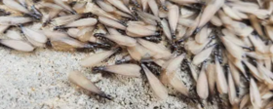
Unlike drywood termites, subterranean termites require contact with soil moisture and travel through mud tubes to reach wood such as framing, beams, and subfloors. A mature colony can contain hundreds of thousands—even millions—of termites.
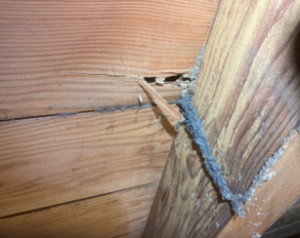
A subterranean termite tube on a beam.
Why Subterranean Termites Are So Destructive
Subterranean termites work from hidden areas like walls and crawlspaces, making them difficult to detect early. They build protective mud tubes to maintain moisture while traveling between soil and wood. Their colonies are large and active year-round, and the damage they cause occurs from the inside out—often leaving wood looking intact while it is structurally compromised.
Why Termites Are Especially Active Right Now
Recent environmental conditions have created ideal circumstances for termite activity. Increased rainfall improves soil moisture, allowing colonies to expand. Warm spring temperatures trigger swarming behavior, while mild winters allow termites to remain active throughout the year.
Signs of a Subterranean Termite Infestation
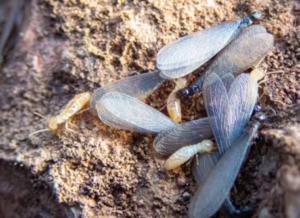
Because subterranean termites stay hidden, early signs can be subtle. Homeowners may notice mud tubes along foundations or crawlspaces, swarming termites near windows, hollow-sounding wood, or blistered surfaces. Discarded wings near doors and windows are also a common indicator of nearby activity.
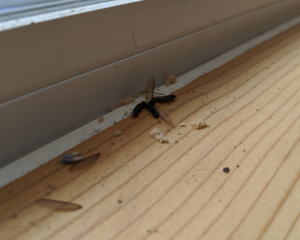
Termites emerge from a window sill in Berkeley. Note their shed wings.
Damage Caused by Subterranean Termites
Subterranean termites consume wood from the inside out, often leaving the outer surface intact while internal damage spreads. Common areas affected include structural framing, crawlspaces, decks, siding, and window or door frames. Left untreated, this damage can weaken structural components and lead to costly repairs. This is why being proactive about having regular termite inspections can make a big difference.
Why the Bay Area Is Prime Termite Territory
The Bay Area provides an ideal environment for termites. Mild temperatures allow year-round activity, while moisture from fog, irrigation, and seasonal rains supports colony growth. Older homes and landscaping near foundations further increase the risk of infestation.
What To Do If You Suspect Termites
If you suspect termite activity, there are a few important steps to take before professional inspection. For best results, contact a trusted termite control provider as soon as possible.
Do:
- Take note of where activity is occurring
- Keep areas accessible for inspection
Do NOT:
- Disturb mud tubes
- Attempt DIY treatments
Our Proven Process: D.I.R.T.
At ATCO, we follow a structured IPM-based approach focused on long-term control—not quick fixes.
Detect – Identify termite activity and conducive conditions such as moisture, soil contact, and structural vulnerabilities.
Inspect – Evaluate the full structure, including crawlspaces, foundations, and areas where termites may be hidden.
Recommend – Provide targeted guidance to correct conditions and reduce future risk.
Treat – Apply solutions designed to eliminate termites at the colony level and protect the structure.
ATCO’s Termite Treatment Methods
Effective termite control requires a combination of tools tailored to the structure and level of activity. For lasting protection, regular termite control monitoring is essential.
Our approach may include comprehensive inspections, liquid termiticide barriers around the foundation, and subterranean termite baiting systems.
Baiting systems are placed in the soil around the structure, where termites feed and carry the material back to the colony—gradually eliminating it. These systems also serve as an early detection and monitoring tool.
Localized treatments may be used in active areas, and ATCO also offers dry rot repair when structural damage is present.
Ongoing monitoring and maintenance help ensure long-term protection.
Preventing Future Infestations
While no home can be completely termite-proof, reducing conducive conditions significantly lowers risk.
This includes managing moisture, maintaining proper drainage, and avoiding wood-to-soil contact.
Landscaping and irrigation near the foundation should be monitored to prevent excess moisture buildup.
A Wood Destroying Organism (WDO) inspection every three years is strongly recommended to detect early activity and prevent larger issues.
Protect Your Home from Subterranean Termites
Subterranean termites are highly destructive but can be effectively managed with early detection and the right approach.
ATCO Pest Control provides long-term, environmentally responsible solutions tailored to Bay Area homes, including inspections, treatment, baiting systems, and ongoing monitoring.
With the right plan in place, your home can remain protected for years to come. Get to know us better at atcopestcontrol.com.